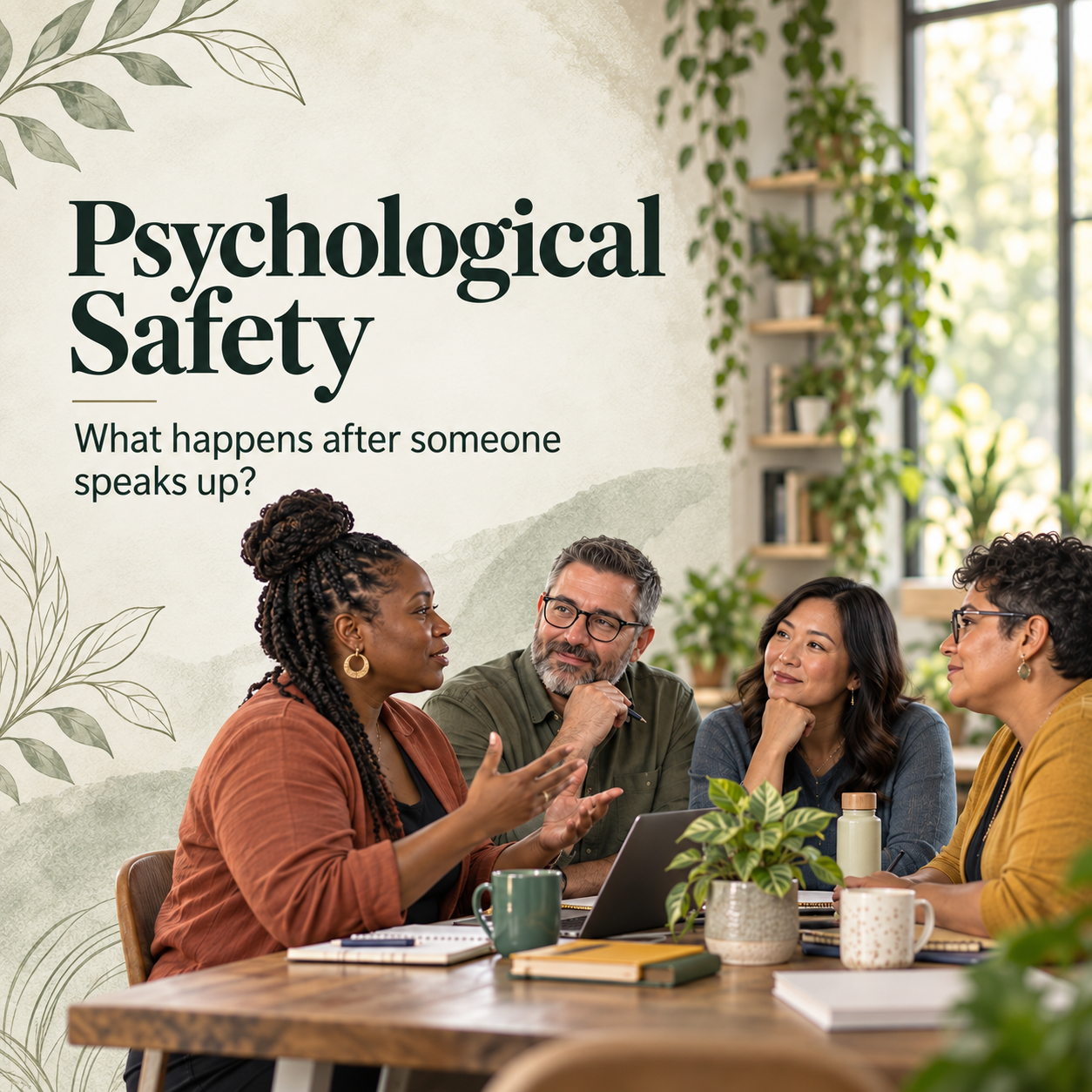
A quiet meeting can look efficient. No one interrupts. No one challenges the plan. The agenda moves forward, and everyone appears to agree.
But silence is not always agreement. Sometimes it is calculation.
People may be deciding whether the question is worth the risk, whether the leader genuinely wants an honest answer, or whether speaking now will create consequences later. When that calculation repeatedly ends in silence, a team can appear aligned while important concerns, mistakes, and better ideas remain hidden.
That is where psychological safety matters. It is not about keeping everyone comfortable or lowering expectations. It is the shared belief that people can take reasonable interpersonal risks—asking questions, admitting uncertainty, offering a different perspective, or naming a mistake—without being punished, humiliated, or pushed outside the group.
Psychological safety is often misunderstood as a personality issue. Leaders may assume that quieter employees simply need to become more confident or outspoken. Sometimes temperament plays a role. But when several capable people consistently hold back, the more useful question is not, “Why won’t they speak?” It is, “What has this environment taught them about speaking?”
Amy Edmondson’s foundational research described team psychological safety as a shared belief that a team is safe for interpersonal risk-taking. Her work connected that belief with learning behaviors such as seeking feedback, discussing errors, asking for help, and experimenting with new approaches. Later reviews have linked psychological safety with employee voice, teamwork, learning, and organizational adaptation.
The practical point is straightforward: people pay attention to what happens after someone tells the truth.
If a concern is dismissed, a mistake becomes ammunition, or disagreement is treated as disloyalty, the team learns quickly. The next meeting may be calmer—but it may also be less honest.
Everyone agrees in the room, yet objections surface in private conversations afterward. Work slows, people quietly resist the plan, or the same decision must be revisited. This pattern may indicate that the meeting produced compliance rather than commitment.
When people delay reporting problems until they are impossible to hide, the issue is rarely a lack of awareness. Employees may have learned that early warnings are unwelcome, especially when the message challenges a preferred narrative or exposes a leadership blind spot.
A team can have lively discussion and still lack psychological safety if only high-status, long-tenured, or leader-aligned employees participate. Pay attention to whose curiosity is welcomed, whose interruptions are tolerated, and whose ideas are repeatedly overlooked.
A lack of reported mistakes does not automatically mean a team is performing flawlessly. It may mean people are protecting themselves. Healthy teams do not celebrate carelessness, but they can examine errors without turning every conversation into a search for someone to blame.
When employees continually look to the leader before sharing an opinion, the team may have become overly dependent on authority. The room waits to discover the “right” answer, and then agreement forms around it. That is not collaboration; it is risk management.
The strongest teams need both candor and standards. Psychological safety without accountability can become avoidance. Accountability without psychological safety can become fear. Effective leadership creates room for people to speak honestly while remaining responsible for the quality, impact, and follow-through of their work.
This distinction matters because leaders sometimes resist psychological safety initiatives out of concern that they will no longer be able to challenge performance. The opposite is closer to the truth. When people can raise problems earlier, ask for clarification, and acknowledge what is not working, accountability becomes more accurate—not less.
Culture is shaped through repeated interactions, not a single workshop or a carefully worded value statement. Leaders can begin by changing what happens in ordinary moments.
· Ask a real question before offering your own conclusion. Once the highest-status person gives an answer, others often organize around it.
· Respond to difficult information with curiosity. Your first reaction teaches the team whether honesty is safe.
· Name uncertainty without abandoning responsibility. Leaders can be decisive and still acknowledge what they do not know.
· Invite missing perspectives specifically. A general “Any thoughts?” is easy to ignore; a focused invitation creates a clearer opening.
· Separate the person from the problem. Examine decisions, systems, assumptions, and consequences without using shame as a management tool.
· Close the loop. When someone raises a concern, explain what will happen next—even when the final decision does not change.
Most importantly, do not ask for candor and then punish people for providing it. Employees will believe the pattern they experience, not the promise printed on the wall.
Psychological safety is not a label a leader can assign to a team. It is an experience that becomes visible through behavior: who speaks, what gets discussed, how mistakes are handled, and whether people can disagree without losing belonging or influence.
A thoughtful assessment will not give you a perfect verdict. It can help you notice patterns, identify where honest conversation has narrowed, and choose a more useful place to begin.
READY TO LOOK BENEATH THE SILENCE?
Download the free What Happens Next? Psychological Safety Audit to explore the conditions shaping voice, trust, learning, and accountability on your team.
GET THE FREE PSYCHOLOGICAL SAFETY AUDIT
The audit is a conversation starter, not a diagnostic or a substitute for a comprehensive organizational assessment.
American Psychological Association. (2024). Psychological safety in the changing workplace: Work in America 2024.
Edmondson, A. C. (1999). Psychological safety and learning behavior in work teams. Administrative Science Quarterly, 44(2), 350–383.
Edmondson, A. C., & Lei, Z. (2014). Psychological safety: The history, renaissance, and future of an interpersonal construct. Annual Review of Organizational Psychology and Organizational Behavior, 1, 23–43.
Edmondson, A. C., & Bransby, D. P. (2023). Psychological safety comes of age: Observed themes in an established literature. Annual Review of Organizational Psychology and Organizational Behavior, 10, 55–78.

Reviving the Belief that Legacy Matters